12 beautiful resident birds, of Delhi’s Urban Jungle….Have you seen them ever ?

If you look out of a window in Delhi, the usual suspects are almost always there: a scavenging House Crow, a pair of Rock Pigeons cooing on an AC ledge, or perhaps the familiar chirp of a House Sparrow. For many, these three define "urban wildlife."
But beneath the chaos of the metro lines and the haze of the morning commute, Delhi is actually one of the most bird-rich capitals in the world. It serves as a sanctuary for resident birds that are far more vibrant and rare than the common urban trio. From the "metronome" of the barbet to the metallic flash of the sunbird, these birds are the city's hidden residents, living in our gardens and parks—if only we knew where to look.

1. Coppersmith Barbet (Psilopogon haemacephalus)
Known as the "Living Metronome," this small, chunky green bird is more often heard than seen. It features a striking crimson forehead and throat patch, contrasted with yellow cheeks and a streaked belly. Its name comes from its repetitive, metallic tuk… tuk… tuk call, which sounds remarkably like a coppersmith hammering metal.

2. Brown-headed Barbet (Psilopogon zeylanicus)
Larger than its coppersmith cousin, this bird is a master of camouflage in the green canopies of Delhi’s "Ridge" areas. It has a streaked brown head, a bright green body, and a prominent yellow patch around the eye. Its loud, rhythmic kutroo-kutroo-kutroo is a signature sound of Delhi’s summer mornings, often echoing from the tops of old Neem or Peepal trees.

3. Oriental White-eye (Zosterops palpebrosus)
This tiny, acrobatic bird is an absolute delight to watch as it flits through garden bushes. It is easily identified by a prominent white ring around its eyes, making it look like it’s wearing miniature spectacles. Its plumage is a bright citron-yellow on the throat and olive-green on the back, and it often hangs upside down to sip nectar from flowers.

4. Rufous Treepie (Dendrocitta vagabunda)
Often called the "Tiger Bird" due to its orange-tawny plumage, this is a member of the crow family but far more elegant. It has a long, graduated silver-grey tail with black tips and a sooty-black head. Tree-pies are highly intelligent and possess a wide repertoire of musical, metallic calls, making them one of the most vocal residents of Delhi’s larger parks like Lodhi Garden.

5. Yellow-footed Green Pigeon (Treron phoenicopterus)
Forget the grey pigeons on your balcony; this is the state bird of Maharashtra and a frequent resident of Delhi’s fruit-bearing trees. It has soft, pastel olive-green feathers and, as the name suggests, bright yellow legs and feet. They are shy birds that blend perfectly into the foliage and are usually found in groups (flocks) feeding on wild figs.

6. Purple Sunbird (Cinnyris asiaticus)
In the right light, the male Purple Sunbird is a shimmering jewel of metallic dark purple and blue. During the non-breeding season, however, they look somewhat like the females—olive-brown above and yellow below—save for a dark central "stripe" on their chest. They are tiny, high-energy birds with downward-curved beaks designed for extracting nectar from tubular flowers.

7. Red-vented Bulbul (Pycnonotus cafer)
A spunky and bold bird, the Red-vented Bulbul is identified by its sooty black crest and a brilliant patch of crimson red under its tail (the "vent"). Its body is covered in a scaly brown pattern, and it is known for being quite fearless around humans. These birds are excellent "alarmists," often being the first to let out a sharp chatter if a cat or snake is nearby.

8. White-throated Kingfisher
A common resident of Delhi, easily identified by its electric blue wings, chocolate-brown body, and distinctive bright white throat. Unlike other kingfishers, it is highly adaptable to urban life and is frequently seen perching on city power lines or in parks, hunting for lizards and large insects. Its loud, rattling call is a staple of the capital’s dawn chorus, echoing through both lush green spaces and busy residential areas.
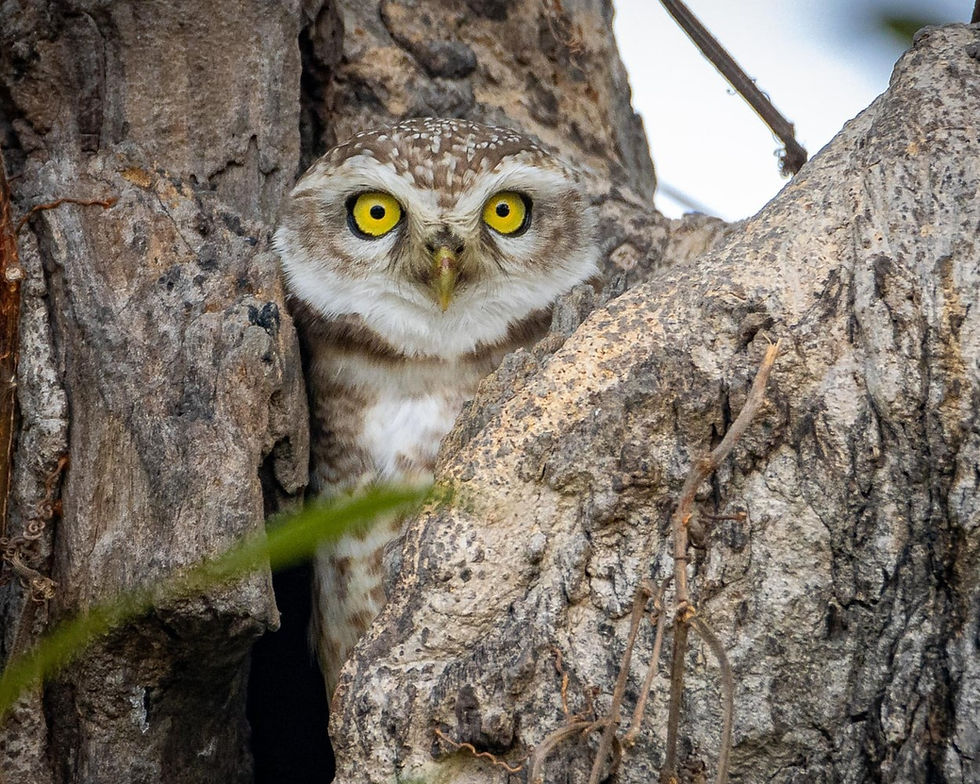
9. Spotted Owlet (Athene brama)
The night guardian of the city, this small, stocky owl is often seen during the day sitting in the hollows of old trees or even on the ledges of old buildings. It is heavily spotted with white over a grey-brown body and has piercing yellow eyes. Interestingly, they often live in pairs and can be seen "bobbing" their heads up and down when they feel observed.

10. Indian Silverbill (Euodice malabarica)
This is a tiny, social finch often found in the drier, scrubby outskirts of Delhi or near the Yamuna floodplains. It has a conical, silver-grey beak, buff-brown upper parts, and a distinct white rump that flashes when it flies. They are usually seen in small flocks, moving through tall grasses in search of seeds while emitting soft, constant chirps.

11. Shikra (Accipiter badius)
The "silent assassin" of the city, the Shikra is a small raptor often seen perched on high wires or hidden branches. It has a pale grey upper body and fine brownish-orange barring on its white underparts, with striking orange-yellow eyes. It is famous for its sudden, high-speed bursts of flight to catch small birds or lizards, often announced by its sharp, high-pitched ti-tui call.

12. Common Tailorbird (Orthotomus sutorius)
A tiny, energetic warbler that lives up to its name with incredible craftsmanship. It has a long, upright tail, a rust-colored crown, and bright green wings. The "tailor" aspect comes from its unique nest-building: it uses its beak like a needle to "sew" the edges of large leaves together using plant fibers or spider silk to create a snug cradle for its eggs.
How We Can Help to protect them…
The transition from a "garden city" to a "concrete jungle" has made life difficult for these birds. Glass buildings lead to fatal collisions, manicured lawns provide no food, and the lack of old trees means no nesting cavities for barbets and owls.
Measures to Protect Avian Populations:
1. Plant Native, Not Decorative: Replace exotic plants like Palm or Ficus benjamina with native fruit-bearing trees like Neem, Jamun, Mulberry (Shahtoot), and Peepal. These provide the specific fruits and insects our local birds need.
2. The "Scruffy" Corner: Avoid over-pruning your garden. A "wild" corner with tall grasses and leaf litter provides a habitat for the Indian Silverbill and insects for the Sunbirds.
3. Water Stations: In the searing Delhi heat, a simple shallow earthen bowl (parinda) filled with fresh water can save lives. Ensure it is placed in a shaded spot away from reach of stray cats.
4. Preserve Old Wood: If a tree has a dead branch that isn't a safety hazard, leave it. Cavity nesters like Barbets and Owlets depend on soft, decaying wood to carve out their homes.
5. Bird-Safe Windows: If you have large glass windows, use decals or patterned screens to prevent birds from seeing a reflection of the sky and flying into the glass.

A beautiful and refreshing peace. God has endowed us with nature's bounty, which we often ignore, as we fail to look in and around us. Thanks for enlightening us. Keep penning such stories.
Best regards